Your Frontline Guide to Sarkari Naukri and Career Opportunities
Your Frontline Guide to Sarkari Naukri and Career Opportunities
Exam Preparation Tips That Actually Work: Smart Study Plan to Score Higher Without Stress
Exam Preparation Tips That Actually Work for Students (2026 Guide)
Introduction
Exams feel hard, not because students are weak, but because most follow the wrong study method. Even after studying for hours, many still forget answers or lose marks. These exam preparation tips that actually work will help you study smart, reduce stress, and score higher with confidence.
These tips are used by toppers, teachers, and successful students who focus on method over memorization. It’s also useful for students preparing for various government exams and competitive tests in India.
Preparing for examinations can feel stressful, confusing, and overwhelming. Every year, millions of students work hard but still fail to get the marks they deserve—not because they lack ability, but because they use the wrong strategy.
This guide is prepared using proven study methods recommended by teachers, examiners, and education experts and is based on techniques that have helped students consistently improve exam performance across school and competitive exams. With the right strategy, smart planning, and healthy habits, exam preparation can become simple, effective, and even enjoyable.
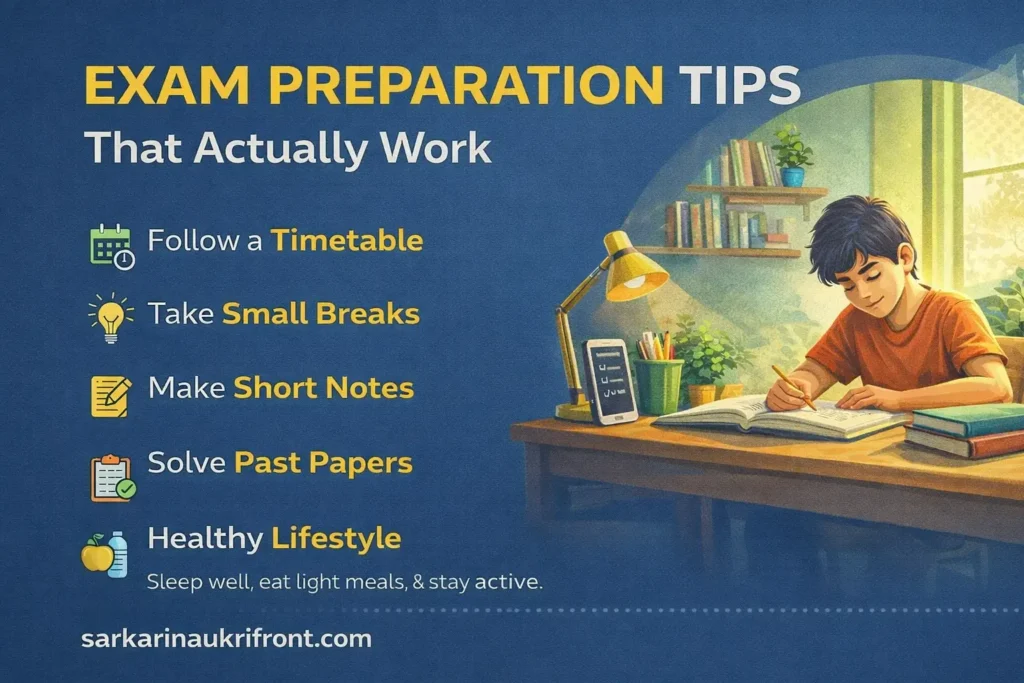
Exam Preparation Tips That Actually Work
📑 Table of Contents ▼
Table of Contents
Importance of Following the Right Exam Preparation Tips
Following the right exam preparation tips for students is important because exams are not just about hard work but also about using the correct method. Many students spend hours studying, but still feel confused because they do not have a clear exam preparation strategy.
When students follow a smart study plan for exams, they understand concepts faster, remember information longer, and feel more confident while writing answers. These study tips for students also help reduce stress, improve time management, and make revision easier. Most importantly, using stress-free exam preparation techniques that actually work allows students to perform at their best without panic or fear, which directly helps in scoring higher marks.
1. Start With the Right Mindset (Most Ignored but Most Powerful)
Education experts agree that mindset directly impacts memory, focus, and performance. Students who believe improvement is possible perform better than those who study with fear.
Building confidence is important, and students can also learn how to cultivate self-belief to stay motivated during exam preparation.
The first step of exam preparation starts in the mind. Many students believe they are “weak” in a subject even before starting, and this negative thinking reduces performance. Instead, remind yourself:
I can improve with practice
Every subject becomes easy with the right method
Mistakes are part of learning
A positive mindset increases concentration and reduces exam fear.
2. Make a Realistic Study Timetable That You Can Actually Follow
A realistic timetable is the backbone of exam preparation. Do not create a timetable that looks good on paper but fails in real life.
How to make a smart timetable:
Study 5–6 focused hours daily
Divide the day into small sessions
Keep time for revision and practice
Include short breaks
Sleep at least 7 hours daily
The 50–10 Rule
Study for 50 minutes, then take a 10-minute break. This keeps the brain active and reduces fatigue.
3. Study Smart, Not Hard: The Topper’s Secret Strategy
Long study hours do not guarantee success. Smart study methods and exam-ready strategy give better results in less time.
Smart techniques:
Focus on important topics first
Practice previous years’ questions
Revise daily instead of weekly
Use short notes and keywords
Learn with examples and diagrams
For exams like DRDO recruitment, conceptual clarity and mock test practice play a key role in selection.
4. Use the Power of Short Notes for Fast Revision
It’s better to implement a smart revision plan. The short notes are a lifesaver during revision time. Write only key points, formulas, dates, and definitions.
How to create effective notes:
Divide the page into sections
Write questions on one side
Answers on the other
Use diagrams, flowcharts, and tables
Highlight important words
5. Color Coding: A Simple Trick to Remember More in Less Time
Color coding is a powerful memory technique. The brain remembers colors faster than plain text.
Example:
Green for formulas
Blue for definitions
Red for important points
Yellow for examples
This method reduces confusion and helps with faster recall during exams.
6. Subject-Wise Preparation Strategy That Works for Every Student
These effective study methods are commonly advised by experienced teachers and toppers because they match how examiners evaluate answers. These are exam preparation tips that actually work for consistent results in any exam.
Mathematics
Practice daily
Start with easy questions
Solve sample papers
Revise formulas every day
Science
Understand concepts, don’t memorize
Use diagrams
Relate theory to real life
Practice numericals
Social Science
Use timelines
Draw maps and charts
Learn keywords
Revise dates regularly
Languages
Read daily
Practice writing
Learn grammar with examples
Improve vocabulary gradually
7. Revise With the Timeline Method (Best for History, Science & Biology)
The timeline method helps students remember events, processes, and sequences easily.
8. What to Eat During Exams to Keep Your Brain Sharp
Food plays a big role in brain performance. Avoid heavy, oily, and junk food.
Best exam foods:
Fruits
Milk and nuts
Light home-cooked meals
Vegetables
Plenty of water
9. How to Write Answers That Get Full Marks
Many students know the answers but lose marks due to poor presentation.
Practice writing:
Use headings and subheadings
Write in points
Draw diagrams where needed
Underline keywords
Keep handwriting clear
10. Why Mock Tests Can Increase Your Score by 20–30%
According to teacher experience and academic research, students who apply exam preparation tips that actually work—especially regular mock tests—perform significantly better because they are mentally trained for exam conditions.
Solve at least 5–10 full-length tests before the exam.
11. How to Control Exam Fear, Stress, and Panic
Psychologists and educators recommend breathing exercises, proper sleep, and structured revision to reduce exam anxiety.
To reduce stress:
Take deep breaths
Do light exercise
Avoid last-minute cramming
Talk to parents or teachers
Sleep well
Remember, one exam does not decide your life.
12. One Day Before Exam: Do This, Avoid That
Revise short notes only
Do not start new topics
Sleep early
Keep exam material ready
Stay calm and confident
13. Exam Day Strategy Used by High Scorers
High scorers do not rely on last-minute luck; they follow exam preparation tips that actually work even on the exam day. They wake up early, eat light food, reach the exam centre on time, and stay calm under pressure. By reading the question paper carefully, starting with easier questions, and managing time wisely, they avoid silly mistakes and maximise their final score with confidence.
Wake up early
Eat light food
Reach the exam center early
Read the question paper carefully
Attempt easy questions first
Manage time wisely
14. After Exam: Move On
After the exam is over, it is important to move on instead of overthinking mistakes. High-performing students understand that exam preparation tips that actually work also include mental discipline after the paper. Replaying answers in your mind only increases stress and affects the next exam. Take a short break, relax your mind, and shift your focus to the upcoming paper with confidence. Staying positive after each exam helps maintain momentum and improves overall performance.
Do not overthink mistakes. Focus on the next paper. Confidence is your biggest strength.
Final Words: Your Marks Will Change If Your Method Changes
This guide, Exam Preparation Tips That Actually Work, follows safe, ethical, and student-friendly preparation practices. These methods are widely used in schools and coaching institutes and recommended by experienced teachers for long-term academic success.
Every student has the potential to do well in exams. Success comes from consistency, clarity, and calmness. Follow these exam preparation tips that actually work, and you will see improvement not only in marks but also in confidence.
For more student-friendly guides, preparation tips, and exam updates, keep learning and keep improving. Share this guide with a friend who is worried about exams. It may help them more than you think.
Author: Sarkari Naukri Front Education Team Reviewed by: Senior Teacher / Academic Expert Last Updated: 28 January 2026
1. How many hours should a student study daily for exams?
There is no fixed number for everyone. Most students perform best by studying 5 to 6 focused hours daily with short breaks. Quality matters more than long hours. Regular revision and practice are more important than studying for 12–14 hours continuously.
2. What is the best way to start exam preparation?
The best way to start is by understanding the syllabus and exam pattern first. Then make a realistic timetable, begin with easy topics, and gradually move to difficult ones. Starting early and studying daily gives better results than last-minute preparation.
3. How can I remember what I studied for a long time?
To remember longer, use short notes, color coding, revision, and practice tests. Revising the same topic multiple times in short intervals helps the brain store information in long-term memory.
4. How can students reduce exam fear and stress?
Exam stress can be reduced by proper sleep, regular breaks, mock tests, and positive thinking. Avoid comparing yourself with others. Deep breathing and light exercise also help keep the mind calm before exams.
5. Is solving previous years’ question papers really useful?
Yes, solving previous years’ papers is one of the most effective exam preparation techniques. It helps you understand important topics, question patterns, and time management, and boosts confidence for the real exam.